

Hello friends, my name is Akshay Bhardwaj and I am a student just like you. I recently cleared my SSC CPO Prelims exam. Right now, I am preparing for the SSC CPO Mains exam and SSC CGL. I know how much English matters for our selection. I am sharing my notes here to help all my fellow SSC aspirants study well.
Why Read This Article?
English grammar can feel very tough, especially for students from Hindi medium or regional language backgrounds. In SSC exams like CGL, CHSL, and CPO, the “Tense” chapter is the base of English. If your tenses are weak, you will lose marks in Error Spotting, Sentence Improvement, and Active-Passive Voice.
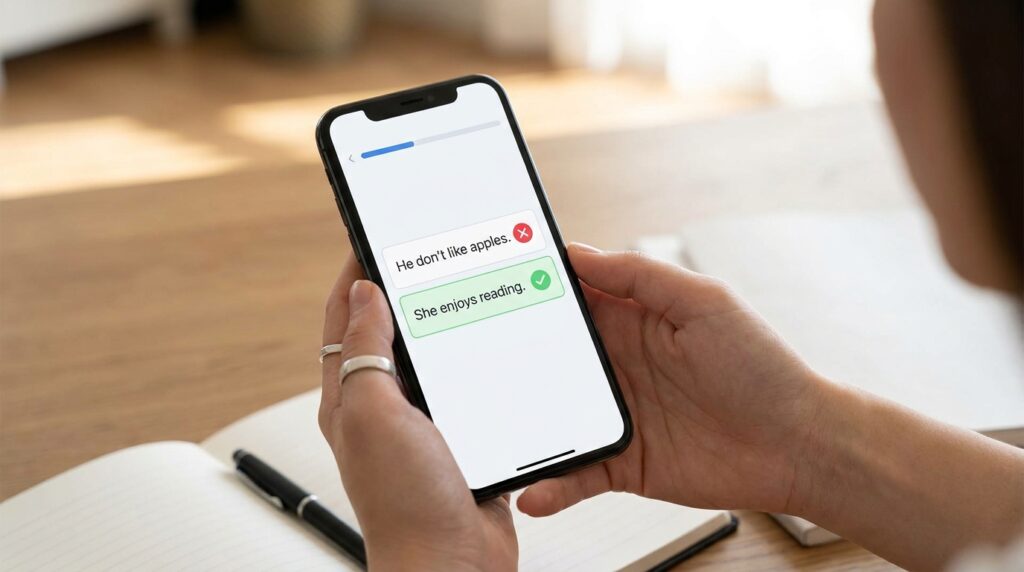
In this article, I am sharing the exact rules that helped me clear my prelims. We will not read boring book language. We will look at the top 25 rules and concept of tense chapter. I have kept the sentences short. The words are simple. Every rule has a correct and an incorrect example so you can understand it easily on your mobile screen.
Check out more – Zero to ASO (CSS) – 5 Rules To Crack SSC CGL 2026 by Mansi Rana { Topper }.
Table of Contents
Let us start our learning journey.
The Top 25 Rules and Concept of Tense Chapter
1. Universal Truths and Facts
Concept – Always use the Simple Present Tense for universal truths, scientific facts, and proverbs. It does not matter if the sentence is talking about the past.
- Incorrect – The teacher said that the earth moved round the sun.
- Correct – The teacher said that the earth moves round the sun.
2. Daily Habits and Routines
Concept – When you talk about a daily habit or routine work, always use the Simple Present Tense. Look for words like daily, usually, often, every day, always.
- Incorrect – He is going for a walk every morning.
- Correct – He goes for a walk every morning.
3. Future Action in Conditional Sentences (If/When clause)
Concept – When two actions happen in the future one after another, the conditional clause (starting with if, when, unless, until) is written in the Simple Present Tense. The main clause stays in the Simple Future.
- Incorrect – If he will come to Delhi, I will meet him.
- Correct – If he comes to Delhi, I will meet him.
4. Stative Verbs (Verbs of State)
Concept – We do not use verbs of senses, emotions, or possession in the Continuous (ing) form. Words like see, hear, smell, know, understand, hate, love, want, own, possess are usually not written with “-ing”.
- Incorrect – I am knowing him very well.
- Correct – I know him very well.
5. Possession with “Have”
Concept – When “have” shows ownership or possession, we never use “having”.
- Incorrect – I am having a red car.
- Correct – I have a red car.
(Note – We can use “having” for eating or experiencing, like “I am having lunch”.)
6. Actions Happening Right Now
Concept – For an action going on at the time of speaking, use the Present Continuous Tense. Look for words like now, at present, at this moment.
- Incorrect – He reads a book right now.
- Correct – He is reading a book right now.
7. Fixed Plans for Near Future
Concept – If you have a fixed plan for the near future, you can use the Present Continuous Tense to show it.
- Incorrect – My uncle will arrive tomorrow. (Grammatically okay, but less natural for fixed plans)
- Correct – My uncle is arriving tomorrow.
8. Recently Completed Actions
Concept – If a work has just finished, use the Present Perfect Tense. Look for words like just, recently, yet, already, lately.
- Incorrect – He just finished his homework.
- Correct – He has just finished his homework.
9. Use of “Yet”
Concept – The word “yet” is used in negative or interrogative sentences. It always takes the Present Perfect Tense.
- Incorrect – The postman did not come yet.
- Correct – The postman has not come yet.
10. Point of Time in the Past
Concept – If a sentence has a past time marker (like yesterday, ago, last week, in 2010), always use the Simple Past Tense. Never use Present Perfect here. This is a very common SSC question.
- Incorrect – I have passed the SSC CGL exam in 2022.
- Correct – I passed the SSC CGL exam in 2022.
11. “Since” and “For” with Present Perfect Continuous
Concept – When an action started in the past and is still going on, use the Present Perfect Continuous Tense. Use “since” for a starting point (Since Monday, Since 2015). Use “for” for a time period (For 2 hours, For 5 years).
- Incorrect – I am studying for this exam since January.
- Correct – I have been studying for this exam since January.
12. “It is time” or “It is high time”
Concept – After the phrases “It is time”, “It is high time”, or “It is about time”, if a subject follows, always use the Simple Past Tense (V2). This shows that an action is already delayed.
- Incorrect – It is high time you start studying for Mains.
- Correct – It is high time you started studying for Mains.
13. Two Actions in the Past (Past Perfect)
Concept – When two actions happen in the past, one after another, the first action takes the Past Perfect (had + V3), and the second action takes the Simple Past (V2).
- Incorrect – The train left before I reached the station.
- Correct – The train had left before I reached the station.
14. Past Actions with “After”
Concept – This is the reverse of the rule above. The action that happens first takes Past Perfect. So, the action after the word “after” will be Past Perfect.
- Incorrect – I reached the station after the train left.
- Correct – I reached the station after the train had left.
15. Ongoing Past Action (Past Continuous)
Concept – If an action was going on in the past and another short action happened in the middle, the long ongoing action takes Past Continuous, and the short action takes Simple Past.
- Incorrect – I read a book when the lights went out.
- Correct – I was reading a book when the lights went out.
16. Two Simultaneous Past Actions
Concept – If two actions were going on at the exact same time in the past, both will be in the Past Continuous Tense. They are usually joined by “while”.
- Incorrect – While my mother cooked, I watched TV.
- Correct – While my mother was cooking, I was watching TV.
17. Sequence of Tense Rule (Past to Past)
Concept – If the main verb of the sentence is in the past tense, the other verbs that follow must also be in the past tense.
- Incorrect – He told me that he is preparing for SSC CPO.
- Correct – He told me that he was preparing for SSC CPO.
(Exception – Rule 1, Universal Truths, does not follow this).
18. Past Perfect Continuous Tense
Concept – When an action started in the past, continued for some time in the past, and finished in the past before another action, we use Past Perfect Continuous.
- Incorrect – He was sleeping for two hours when I woke him up.
- Correct – He had been sleeping for two hours when I woke him up.
19. Simple Future Tense
Concept – Use Simple Future (will/shall + V1) for actions that will happen in the future. “Shall” is normally used with I and We, while “Will” is used with others. But in modern English, “will” is accepted everywhere.
- Incorrect – I going to market tomorrow.
- Correct – I will go to the market tomorrow.
20. Future Perfect Tense (Deadlines)
Concept – When an action will be completed in the future by a certain time (deadline), we use the Future Perfect Tense (will have + V3). Look for the word “by” (by tomorrow, by next month).
- Incorrect – I will complete this syllabus by next week.
- Correct – I will have completed this syllabus by next week.
21. Use of “Lest”
Concept – The word “lest” means “so that you do not”. It is a negative word. It is always followed by “should” + V1. Never use “not” after lest.
- Incorrect – Work hard lest you will fail.
- Correct – Work hard lest you should fail.
22. As if / As though (Imaginary Situation)
Concept – When a sentence shows an imaginary situation in the present using “as if” or “as though”, we use the Simple Past (and always use “were” for the “be” verb, even with singular subjects).
- Incorrect – He orders me around as if he is my boss.
- Correct – He orders me around as if he were my boss.
23. Suppositional Sentences (If, I wish)
Concept – Like rule 22, when we wish for something impossible in the present, we always use “were” for all subjects (I, he, she, it).
- Incorrect – I wish I was the Prime Minister of India.
- Correct – I wish I were the Prime Minister of India.
24. Past Unfulfilled Condition (Third Conditional)
Concept – When talking about a past situation that did not happen, the structure is – If + Past Perfect, Subject + would have + V3.
- Incorrect – If you worked hard, you would have passed the exam.
- Correct – If you had worked hard, you would have passed the exam.
25. Hope vs. Expect vs. Wait
Concept – Sometimes SSC asks vocabulary-based tense questions. Use “hope” for something good in the future. Use “expect” when you think something will happen (good or bad). Use “wait” for physical time passing.
- Incorrect – I am waiting that you will pass the SSC CGL exam.
- Correct – I hope that you will pass the SSC CGL exam.
Final Words for My Fellow Aspirants
Friends, English grammar is totally based on logic and practice. Reading these rules one time is not enough. To truly master the top 25 rules and concept of tense chapter, you need to practice chapter-wise mock tests and previous year questions (PYQs).
Whenever you read a newspaper or a book, try to find these rules in the sentences. Ask yourself – “Why did the writer use Past Perfect here?” When you start asking ‘why’, your grammar will improve very fast.
I am also studying for my SSC CPO Mains and CGL exams, and I apply these exact concepts daily in my mock tests. Let us study hard, stick to our daily targets, and get that uniform and inspector post this year.
All the best for your exams. Keep working hard and don’t forget to fill the SSC CGL 2026 Application.
1 thought on “Mastering English – Top 25 Rules and Concept of Tense Chapter for SSC Exams”