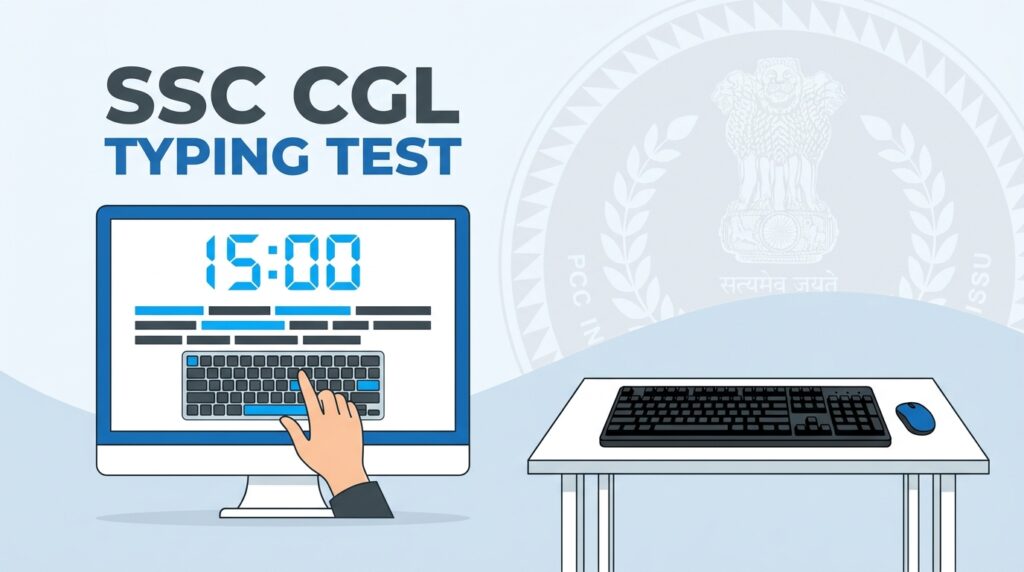
Backspace is allowed. Copy-pasting is disabled. The 15-minute timer starts on your first key press.
Time Left: 15:00Target: 27 WPM (2000 Key Depressions)
Education is the most powerful tool a person can have in the modern world. It gives us the knowledge and skills needed to improve our lives and help our country grow. In recent years, the way we learn has changed deeply. Technology has become a central part of the classroom. Students no longer rely only on heavy textbooks. Instead, they use laptops, tablets, and the internet to find information instantly. This shift has made learning much more interactive and exciting. However, technology alone is not enough to achieve success. Hard work and daily discipline are just as important today as they were in the past. When preparing for competitive exams, a student must follow a strict routine. Waking up early, reading the daily news, and solving math problems require high mental focus. Distractions are everywhere, especially on mobile phones and social media. A serious candidate must learn to ignore these distractions and stay focused on their final goal. Government jobs offer great stability and a chance to serve the public. To secure these positions, candidates must prove their abilities in multiple ways. Passing the written test shows that a person has good knowledge of subjects like science, history, and reasoning. But practical skills are also tested. This is why the typing speed test is a mandatory step for many clerical and administrative roles. Working in a modern government office requires handling hundreds of emails, digital files, and official reports every single week. If an officer cannot type quickly and accurately, the work of the entire department slows down. Practicing for a typing test is like training for a sport. You cannot build speed in a single day. Your fingers must learn the exact position of every key on the keyboard. This is called muscle memory. At first, you will make many mistakes, and your speed will be very slow. You might feel frustrated and want to look down at your hands. But you must resist this urge. Keep your eyes on the computer screen at all times. Sit with a straight back and place your feet flat on the floor. Good posture prevents back pain and keeps your energy levels high during long study sessions. Remember to take small breaks. Staring at a bright screen for hours can strain your eyes. Every twenty minutes, look away from the monitor and focus on a distant object. Drink plenty of water and eat healthy food to keep your brain active. Success in these exams is a marathon, not a short sprint. Stay positive, help your fellow students, and never give up on your dreams. With consistent practice and a clear mind, you will surely clear the upcoming exams and secure a bright future. To clear the Staff Selection Commission Combined Graduate Level examination, a student must understand that every single tier requires a unique mindset. The first tier tests your general speed and basic knowledge across four distinct subjects. Mathematics requires deep conceptual clarity and a massive amount of formulas layout. Reasoning checks your mental agility and how fast you can find patterns under pressure. English language skills are essential because every government officer must communicate clearly in official files. General awareness is a vast ocean that includes everything from ancient history to the latest scientific developments. If you study systematically, you can easily make it to the next round. Once you enter the secondary phase of the selection process, the level of competition rises heavily. This is where your deep analytical skills are put to the ultimate test. You must spend hours resolving previous year question papers to understand the exact pattern used by the commission. Many aspirants make the mistake of reading new books every week. The secret to ranking high is simple: read the same standard textbook multiple times until you memorize every concept completely. Group study with serious friends can also boost your preparation, as it allows you to discuss difficult problems and learn shortcut methods. However, always ensure that your study circle remains focused and does not waste time on idle gossip. Along with your daily study routine, physical fitness must not be ignored. Many students sit in a dark room for twelve hours continuously without any physical activity. This lifestyle causes extreme fatigue and reduces your memory power over time. Spend at least thirty minutes in the evening walking in a park or doing basic exercises. This increases oxygen flow to your brain and keeps you fresh for your night study sessions. Proper sleep is another critical factor. Your brain needs at least seven hours of deep sleep to process and store all the information you learned during the day. Staying up late drinking coffee before the exam day will only make you feel anxious and lead to silly mistakes in the exam hall. Let us look closely at the data entry speed test which is the final hurdle for the top posts. The commission expects you to type two thousand key depressions in exactly fifteen minutes. This might sound simple to an experienced computer user, but under the high pressure of the examination center, even basic words feel difficult to type. The sound of hundreds of other candidates hitting their keys at the same time can create a lot of noise. If you are not used to this environment, you might lose your concentration and make critical errors. To overcome this, you should practice typing with a keyboard while playing keyboard typing ambient sounds on your phone. This simulates the real exam hall feel and trains your mind to stay calm despite the surrounding noise. Another common mistake candidates make is practicing exclusively on soft laptop keyboards. Laptop keys have a very short travel distance and require minimal force to press. On the other hand, the examination centers plug in traditional desktop keyboards which are often old and have stiff keys. If you have only practiced on a smooth laptop, your fingers will tire out within the first five minutes of the real test, causing your typing speed to drop significantly. Therefore, invest in a cheap, external mechanical keyboard for your daily practice sessions. This small investment can save you from a major failure at the very end of your selection journey. Accuracy should always be your main goal during your preparation weeks. Since the commission allows a specific percentage of errors based on your reservation category, some students become reckless and type as fast as possible without caring about mistakes. This is a highly dangerous strategy. When you type with low accuracy, you build bad habits that are extremely difficult to fix later. If you focus entirely on hitting the correct keys without making errors, your speed will naturally increase over time. Start by typing paragraphs slowly and consciously. Once you can type a full page without a single error, speed up your pace gradually. This systematic approach ensures a definite pass status on the results screen. In addition to regular typing work, make sure your general computer knowledge is up to mark. The modern digital governance model demands that every assistant section officer and inspector be fully familiar with spreadsheets, word documents, and basic presentation tools. You will be using these software solutions daily to draft official letters, maintain public records, and analyze complex data structures. Having a strong command over these basic tools will not only help you clear the qualifying computer module but will also make your initial training period much smoother once you join your respective ministry. Keep your motivation levels high throughout this long journey. There will be days when your mock test scores drop, and you will feel like giving up. This is completely natural and happens to every single topper. Treat low scores as an opportunity to find your weak spots and work on them immediately. Consistency is what separates an ordinary applicant from a successful officer. Keep pushing forward every single day, look after your health, and believe in your hard work. The days of struggle will pass, and the reward of seeing your name on the final merit list will make every single sacrifice completely worth it. Stay dedicated, practice hard, and success will surely be yours.
SSC CGL Free Typing Test 2026
SSC CGL Free Typing Test 2026 Online – Rules & Free Practice Typing Test
Hello friends, It is Akshay Bhardwaj here again. As you know, I am currently preparing for the SSC CGL exam and gearing up for my SSC CPO Mains after clearing the Prelims.
Yesterday, we discussed the strict RRB NTPC typing rules. Today, we need to talk about the biggest exam for us the Staff Selection Commission Combined Graduate Level (SSC CGL) exam. The Data Entry Speed Test (DEST) is a mandatory qualifying stage for this exam. Many students work extremely hard to clear the Tier-1 and Tier-2 written exams, only to fail the typing test because they did not practice properly or understand the real rules.
To help my fellow aspirants, I have written this guide explaining the exact SSC CGL 2026 typing test rules. I have also built a custom, full-screen practice tool that you can use right here on this website to build your speed.
Exam Rules for SSC CGL 2026 Typing Test (DEST)
The SSC CGL typing test is slightly different and, in some ways, more forgiving than the Railway exams. However, the evaluation is still very strict. Here is what you will actually face in the exam hall –
The Target – You are required to type exactly 2000 key depressions within 15 minutes.
The Speed – When you calculate 2000 key depressions over 15 minutes, it comes out to an approximate speed of 27 Words Per Minute (WPM).
Backspace is allowed – Unlike RRB exams, the SSC CGL DEST generally allows you to use the backspace key to correct your mistakes during the test. You are also allowed to use the arrow keys to navigate.
Error Limits by Category – You do not have to be 100% perfect. The commission allows a maximum error percentage of 20% for the UR (General) category, 25% for OBC and EWS candidates, and 30% for SC and ST candidates.
How SSC Calculates Full and Half Mistakes
SSC does not treat all typing mistakes equally. They divide errors into two categories –
Full Mistakes (Heavy Penalty) –
Missing a complete word or figure from the text.
Adding an extra word that is not in the original passage.
Spelling errors, such as typing “seplling” instead of “spelling”.
Half Mistakes (Lighter Penalty) –
Spacing errors, like forgetting to put a space between two words.
Wrong capitalization, such as using a capital letter when a small letter is required.
Missing or adding wrong punctuation marks like commas or full stops.
1 thought on “SSC CGL Free Typing Test 2026 – Test Your Speed”

1 thought on “SSC CGL Free Typing Test 2026 – Test Your Speed”